

As a supplier of H Steel Beam, I've often been asked about the torsional resistance of H Steel Beams. In this blog post, I'll delve into the concept of torsional resistance, explore the factors that affect it, and discuss its importance in structural applications.
Understanding Torsional Resistance
Torsional resistance refers to the ability of a structural member to resist twisting or torsion when subjected to a torque or twisting force. In the case of H Steel Beams, torsional resistance is crucial as they are commonly used in structures where they may be exposed to torsional loads. For example, in industrial buildings with cranes or in bridges where wind or seismic forces can induce torsion.
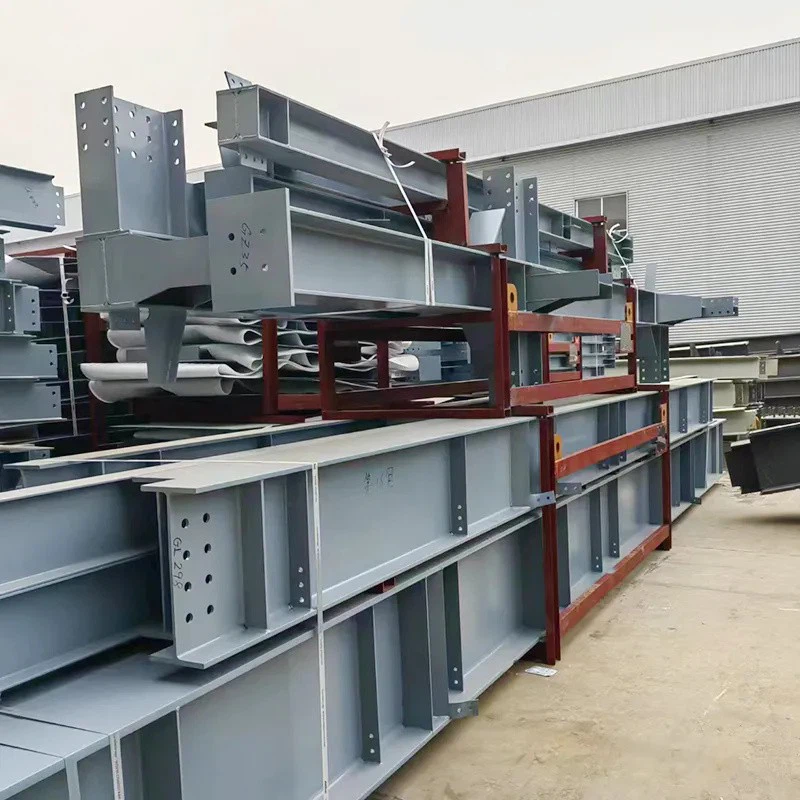
The cross - sectional shape of an H Steel Beam plays a significant role in its torsional resistance. The typical H - shaped cross - section of an H Steel Beam consists of two flanges and a web. The flanges are located at the top and bottom of the beam, while the web connects them. This shape provides a relatively high moment of inertia about the major and minor axes, which contributes to its overall strength and stiffness. However, when it comes to torsional resistance, the distribution of material and the geometry of the cross - section are of utmost importance.

Factors Affecting Torsional Resistance
1. Cross - Sectional Geometry
The width and thickness of the flanges and the web have a direct impact on the torsional resistance of an H Steel Beam. A wider flange generally increases the torsional resistance as it provides more material at the outer edges of the cross - section, which is more effective in resisting torsion. Similarly, a thicker web can enhance the beam's ability to transfer shear stresses and resist twisting.
The ratio of the flange width to the web height also affects torsional behavior. A more balanced ratio can lead to better torsional performance. For instance, if the flanges are too narrow compared to the web height, the beam may be more prone to torsional instability.
2. Material Properties
The type of steel used in the fabrication of the H Steel Beam is another critical factor. High - strength steels typically have better torsional resistance compared to lower - strength steels. This is because high - strength steels can withstand higher stresses before yielding or failing. The modulus of elasticity of the steel also influences torsional behavior. A higher modulus of elasticity means that the beam will deform less under a given torsional load, resulting in better torsional resistance.
3. Length of the Beam
The length of the H Steel Beam is an important consideration. Longer beams are generally more susceptible to torsional effects. As the length increases, the beam becomes more flexible, and the torsional deformation can become more significant. Additionally, the end conditions of the beam play a role. If the beam is fixed at both ends, it will have better torsional resistance compared to a simply - supported beam. Fixed - end conditions restrict the rotation of the beam at the supports, which helps to reduce torsional deformation.
4. Loading Conditions
The type and magnitude of the torsional load applied to the H Steel Beam are crucial. A static torsional load, such as that caused by a stationary machine on a beam, may have different effects compared to a dynamic torsional load, such as that induced by wind or seismic forces. Dynamic loads can cause cyclic stressing, which may lead to fatigue failure over time. The location of the load application also matters. A load applied at the end of the beam may cause different torsional effects compared to a load applied at the mid - span.
Importance of Torsional Resistance in Structural Applications
In structural engineering, ensuring adequate torsional resistance of H Steel Beams is essential for the safety and stability of the entire structure. For example, in multi - story buildings, H Steel Beams are used in the framing system. If these beams do not have sufficient torsional resistance, they may twist under the action of lateral loads, such as wind or earthquake forces. This can lead to misalignment of the structural components, increased stresses in other parts of the structure, and ultimately, structural failure.
In industrial structures, such as factories with overhead cranes, the H Steel Beams that support the crane rails must be able to resist the torsional loads generated by the movement of the cranes. Insufficient torsional resistance can result in excessive deflection and twisting of the beams, which can affect the smooth operation of the cranes and pose a safety risk to the workers and equipment in the facility.
Design Considerations for Torsional Resistance
When designing structures using H Steel Beams, engineers need to carefully consider the torsional resistance requirements. This involves performing detailed structural analyses using advanced software tools that can accurately model the behavior of the beams under torsional loads.
One approach is to use additional bracing or stiffeners to enhance the torsional resistance of the H Steel Beams. Bracing can be in the form of diagonal members that connect the beams to other structural elements, such as columns or walls. Stiffeners can be welded to the flanges or the web of the beam to increase its stiffness and torsional capacity.
Another design consideration is to select the appropriate size and shape of the H Steel Beam based on the expected torsional loads. Engineers may refer to design codes and standards, such as the American Institute of Steel Construction (AISC) specifications, which provide guidelines for the design of steel structures, including provisions for torsional resistance.
Our Offer as an H Steel Beam Supplier
As a reliable supplier of H Beam, we understand the importance of torsional resistance in structural applications. We offer a wide range of H Steel Beams with different cross - sectional dimensions and material grades to meet the diverse needs of our customers.
Our H Steel Beams are fabricated using high - quality steel materials and advanced manufacturing processes. We ensure that each beam meets the strictest quality standards and undergoes rigorous testing to guarantee its mechanical properties, including torsional resistance.
If you are involved in a construction project that requires H Steel Beams with excellent torsional resistance, we invite you to contact us for a detailed discussion. Our team of experts can provide you with technical support and help you select the most suitable H Steel Beams for your specific application. Whether you are building a small commercial building or a large industrial complex, we have the products and expertise to meet your requirements.
References
- American Institute of Steel Construction. (2017). Specification for Structural Steel Buildings.
- Blodgett, O. W. (1966). Design of Welded Structures. James F. Lincoln Arc Welding Foundation.
- Timoshenko, S. P., & Goodier, J. N. (1970). Theory of Elasticity. McGraw - Hill.