

Hey there! As a supplier of H Steel Beams, I often get asked about how to calculate the buckling load of these beams. It's a crucial aspect, especially for those in the construction and engineering fields. Understanding the buckling load helps ensure the safety and stability of structures where H Steel Beams are used. So, let's dive right into it.
What is Buckling?
Before we get into the calculations, let's quickly talk about what buckling is. Buckling is a form of structural failure where a beam or column suddenly bends or deflects sideways under a compressive load. It's not the same as simple compression failure, where the material just crushes. Buckling happens when the load causes the beam to lose its straight shape and start to deform laterally. This can be extremely dangerous in real - world applications, as it can lead to the collapse of an entire structure.
Factors Affecting Buckling Load of H Steel Beam
Several factors come into play when calculating the buckling load of an H Steel Beam.
- Material Properties: The type of steel used in the H Steel Beam is crucial. Different steels have different yield strengths and elastic moduli. For example, high - strength steels can generally withstand higher loads before buckling compared to lower - strength steels. The elastic modulus, which measures a material's stiffness, also affects how much the beam can deflect under load.
- Cross - Sectional Dimensions: The shape and size of the H Steel Beam's cross - section matter a lot. The height, width, and thickness of the flanges and web all influence the beam's resistance to buckling. A beam with a larger cross - sectional area or a more efficient shape (like a well - proportioned H shape) will have a higher buckling load.
- Length of the Beam: The longer the beam, the more likely it is to buckle. As the length increases, the beam becomes more flexible and is more prone to lateral deflection under a compressive load. This is why longer beams usually require additional support or have lower allowable loads.
- End Conditions: How the beam is supported at its ends also affects the buckling load. There are different types of end conditions, such as fixed - fixed, fixed - pinned, and pinned - pinned. A beam with fixed ends is more resistant to buckling than a beam with pinned ends because the fixed ends restrict rotation and lateral movement.
Calculation Methods
There are a few different ways to calculate the buckling load of an H Steel Beam. One of the most common methods is using Euler's formula.
Euler's Formula
Euler's formula is used to calculate the critical buckling load ($P_{cr}$) for an ideal, slender column. The formula is given by:
$P_{cr}=\frac{\pi^{2}EI}{(KL)^{2}}$
Where:

- $E$ is the modulus of elasticity of the steel. You can find this value in material property tables. For most structural steels, $E$ is around $200\times10^{9}\ Pa$.
- $I$ is the moment of inertia of the beam's cross - section. The moment of inertia depends on the shape and dimensions of the cross - section. For an H Steel Beam, calculating $I$ can be a bit complex as it involves the geometry of the flanges and web. You can use engineering handbooks or software to find the moment of inertia for a specific H Beam H Beam.
- $K$ is the effective length factor, which depends on the end conditions of the beam. For a pinned - pinned beam, $K = 1$; for a fixed - fixed beam, $K=0.5$; and for a fixed - pinned beam, $K = 0.7$.
- $L$ is the actual length of the beam.
Let's say we have an H Steel Beam H Steel Beam with a modulus of elasticity $E = 200\times10^{9}\ Pa$, a moment of inertia $I=1.2\times10^{-5}\ m^{4}$, an effective length factor $K = 1$ (pinned - pinned ends), and a length $L = 5\ m$.
$P_{cr}=\frac{\pi^{2}\times200\times10^{9}\times1.2\times10^{-5}}{(1\times5)^{2}}$
$P_{cr}=\frac{\pi^{2}\times200\times10^{9}\times1.2\times10^{-5}}{25}$
$P_{cr}=\frac{9.87\times200\times10^{9}\times1.2\times10^{-5}}{25}$
$P_{cr}=\frac{9.87\times2.4\times10^{5}}{25}$
$P_{cr}=94752\ N$
Limitations of Euler's Formula
Euler's formula has some limitations. It assumes that the beam is perfectly straight, the load is applied exactly axially, and the material behaves elastically. In real - world situations, these conditions are rarely met. For example, there may be some initial imperfections in the beam's shape, or the load may not be applied exactly at the center of the cross - section.
Empirical Formulas
In addition to Euler's formula, there are also empirical formulas that take into account some of the real - world factors. These formulas are often based on experimental data and can provide more accurate results for practical applications. For example, the AISC (American Institute of Steel Construction) provides design guidelines and formulas for calculating the buckling load of steel beams and columns. These formulas consider factors such as the slenderness ratio of the beam and the yield strength of the steel.
Practical Considerations
When calculating the buckling load of an H Steel Beam, it's important to keep a few practical things in mind.

- Safety Factors: In real - world design, we always use safety factors. A safety factor is a multiplier applied to the calculated buckling load to account for uncertainties in the material properties, loading conditions, and construction quality. For example, a safety factor of 1.5 means that the actual allowable load on the beam is 1/1.5 of the calculated buckling load.
- Combined Loads: In most structures, H Steel Beams are subjected to combined loads, such as bending, shear, and axial compression. When calculating the buckling load, you need to consider these combined effects. There are methods and design codes available to handle combined loading situations.
- Inspection and Maintenance: Even after calculating the buckling load and designing the structure, it's important to regularly inspect and maintain the H Steel Beams. Corrosion, fatigue, and other factors can reduce the beam's strength over time, increasing the risk of buckling.
Why Choose Our H Steel Beams
As a supplier of H Steel Beams, we offer high - quality products that are designed to meet the highest standards. Our H Steel Beams are made from top - grade steel, ensuring excellent material properties. We have a wide range of cross - sectional dimensions available, so you can choose the right beam for your specific application.
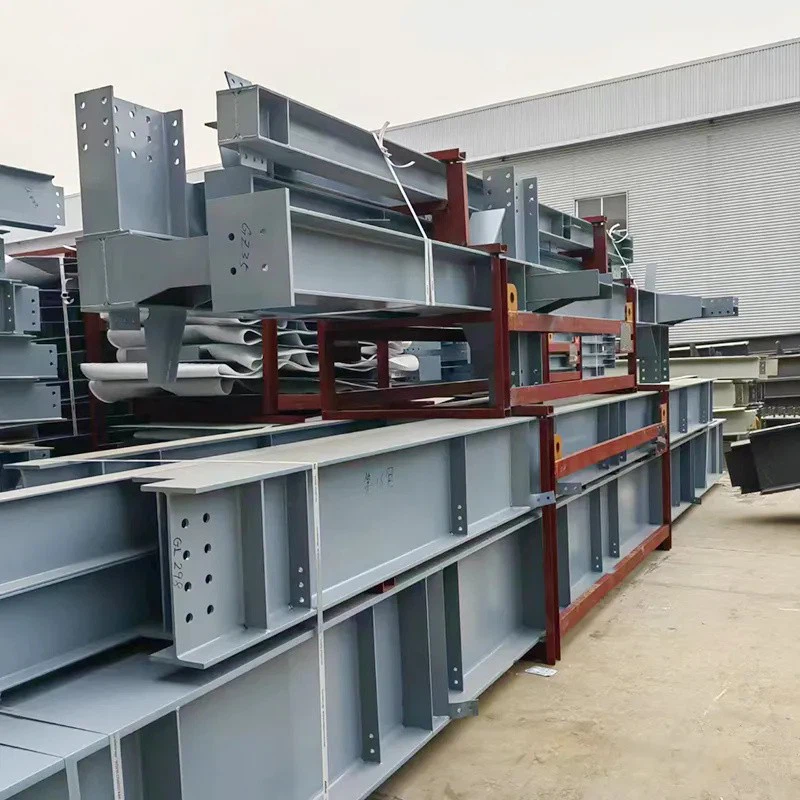
When you buy our H Steel Beams, you can be confident that they will perform well under load. We have a team of experts who can help you with the selection process and provide guidance on calculating the buckling load. Whether you're working on a small building project or a large industrial structure, we have the right solution for you.
If you're interested in purchasing H Steel Beams or have any questions about calculating the buckling load, don't hesitate to get in touch. We're here to assist you with all your steel beam needs and help you ensure the safety and stability of your structures. Contact us today to start the procurement process and let's work together to make your project a success!
References
- "Mechanics of Materials" by Ferdinand P. Beer, E. Russell Johnston Jr., John T. DeWolf, and David F. Mazurek.
- American Institute of Steel Construction (AISC) Manual of Steel Construction.